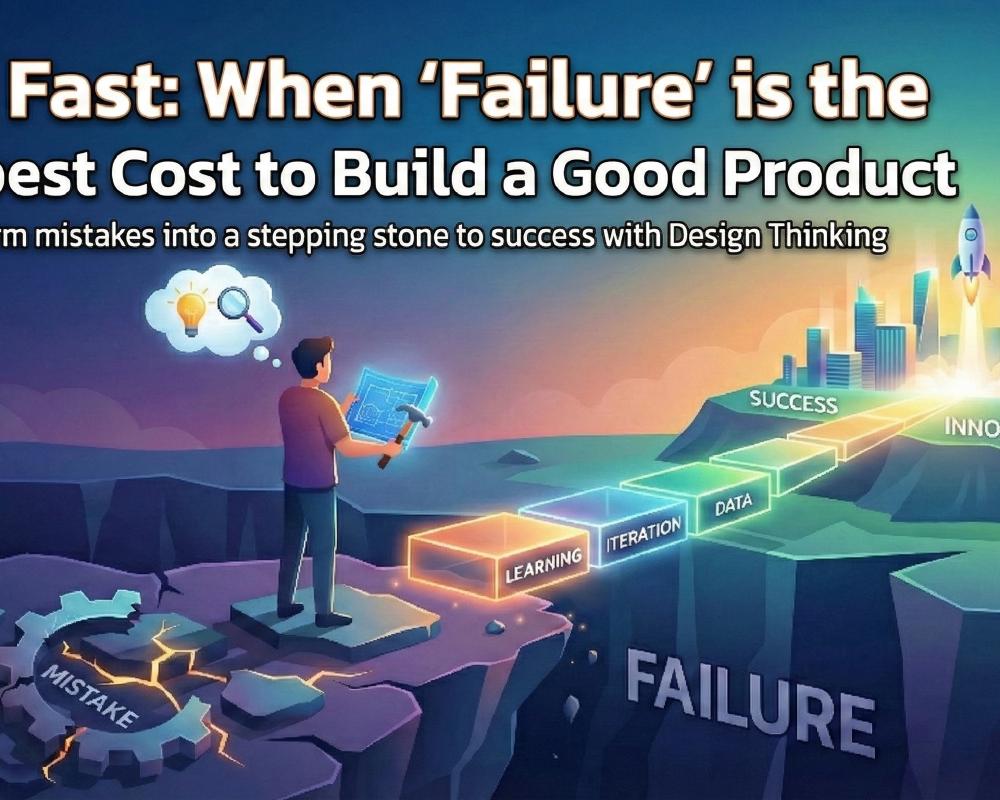
In the world of work, especially when building a Product, we are often taught to fear mistakes. We are conditioned to believe that perfection is the finish line and failure is something to avoid at all costs.
But in the reality of today’s fast-paced world… “Perfection that comes too late might be worth zero.”
Today, I want to invite everyone to adjust their perspective on Fail Fast through a thought process called Design Thinking, to see why daring to fail early is actually the safest strategy in business.
The True Meaning of “Fail Fast”
Many people misunderstand Fail Fast as doing sloppy work or just letting things break. In reality, Fail Fast is a philosophy of “Risk Management.”
It is asking the question:
“How can we learn the most important things using the least amount of resources (money, time, labor)?”
Because failing while we are still drafting on paper is always less painful than failing on the day we have invested in building a factory or writing millions of lines of code.
Design Thinking: The Tool That Helps Us “Fail” Valuably
When we pair Fail Fast with Design Thinking, we find that every step is designed for us to “test fail” in a safe space to harvest “lessons” for improvement.
1. Empathize & Define: Ditching Wrong Assumptions
The scariest starting point isn’t making an ugly Product, but making a Product that “no one wants.” The first step of Fail Fast starts with walking in to talk to real users.
- What happens: We might find that the problem we thought was huge is actually trivial for the customer.
- The Lesson: Admitting that “what we thought all along was wrong” is the first failure of immense value because it stops us from walking the wrong path from the very first step.
2. Ideate: The Space for Trial and Error
In the brainstorming phase, we often fall into the “love at first sight” trap with the first idea we think of.
- Concept: Allow the team to propose ideas that are “crazy” or “impossible” as much as possible.
- Filtering: Throwing away 99 ideas to leave 1 right idea isn’t waste, but a necessary filtering process to ensure we are betting on what is most worthwhile.
3. Prototype: Build to Learn, Not Build to Sell
This is the heart of Fail Fast. Instead of secretly building the Product to 100% completion, we should create something called an MVP (Minimum Viable Product) or just a simple model.
- It might be just a drawing on paper (Sketch).
- Or a cardboard model that is tangible.
- Goal: Make it as fast as possible to spark questions and criticism.
4. Test: The Moment of Truth
Taking the Prototype to test isn’t to receive compliments like “So pretty,” but to observe real behavior.
- If the user is confused, can’t use it, or ignores the feature we are proud of… that is good news.
- The good news is that we have “failed” at the lowest cost, and the data from that failure is the compass that tells us where to adjust to make the real Product most complete.
Turn “Fear” into “Learning”
Ultimately, building a Product with the Fail Fast and Design Thinking mindset doesn’t teach us to be losers, but teaches us to be “Learners.”
In a constantly changing world, successful people aren’t those who “never fail,” but those who “get up the fastest” and take lessons from those scrapes to create things that truly answer people’s needs.
Hope this article is useful for you to dare to try and fail systematically to get a product that meets customer needs. Ask yourself…
Have you tried to “fail” to learn something new today?