
Successful innovation doesn’t happen by just “sitting in an ivory tower” and brainstorming in a meeting room. It often stems from understanding the real problems of users.
Today, I have summarized key concepts from the legendary book, “The Innovator’s Toolkit,” part of the Harvard Business Essentials series, along with related articles from the Harvard Business Review (HBR).
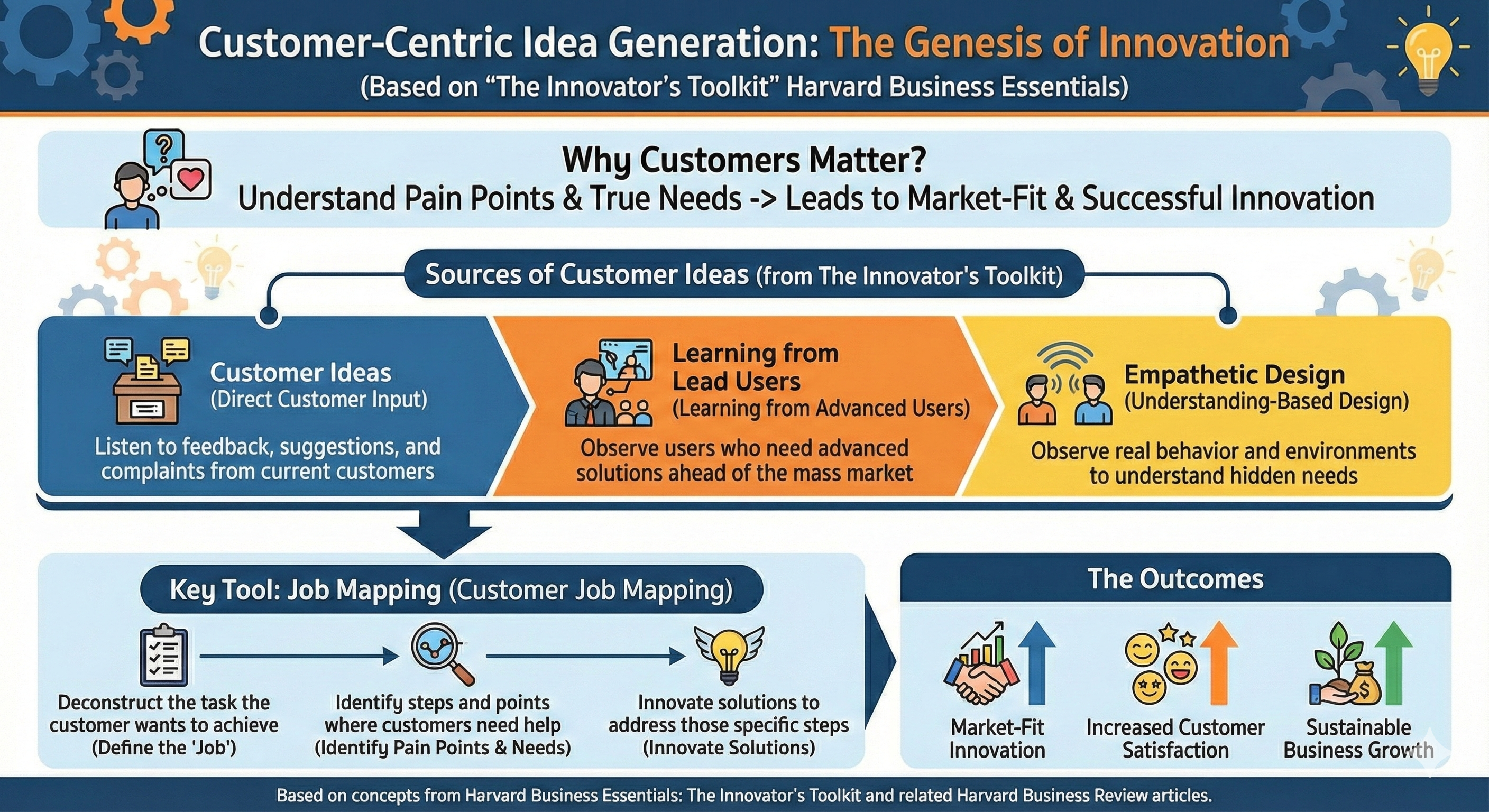
The core concept is shifting the perspective from “build a product and then find customers” to “understand customers to build products that solve their needs.” This is summarized in the infographic below.
Why Do Customers Matter Most?
The starting point of valuable innovation is finding the “Pain Points”—the difficulties or frustrations customers are facing.
If we understand their true needs (which sometimes customers can’t articulate directly), we can create innovations that precisely solve those problems, leading to market success.
3 Sources of “Great Ideas” from Customers
According to The Innovator’s Toolkit, we don’t just wait for customers to walk up and tell us. We need a process to find ideas, which is divided into 3 main approaches:
1. Customer Ideas (Direct Customer Input)
This is the most basic but powerful method: “Listening.” This channel includes:
- Suggestions submitted by customers.
- Complaints (these are excellent goldmines of Pain Points).
- Talking with current customers for feedback.
2. Learning from Lead Users
“Lead Users” are a group of customers who encounter problems and try to find solutions themselves ahead of the majority of the market (e.g., people who modify sports equipment to perform better).
- How to do it: Observe and learn from this group, because the solutions they need today are often what the mass market will want in the future.
3. Empathetic Design
Sometimes customers don’t know what they want or can’t explain the problem. This method focuses on “observation” instead of asking.
- How to do it: Observe behavior in real-world usage environments. See how they live and where they struggle in order to unearth “Unmet Needs” that even the customers themselves might not realize.
Key Tool: Job Mapping (Customer Job Mapping)
Once raw data is gathered from the 3 sources above, Harvard Business Review recommends a tool called “Job Mapping” to turn data into an action plan:
- Define the ‘Job’: Identify what “job” or “mission” the customer is trying to achieve (e.g., a customer doesn’t want to buy a drill; they want a “hole in the wall”).
- Identify Pain Points & Needs: Deconstruct that job into steps and use a magnifying glass to examine where there is friction, difficulty, or a need for help in each step.
- Innovate Solutions: Once the problems in each step are clear, then brainstorm to create innovations to solve problems at those specific points.
The Outcomes
Shifting the mindset to start with the customer doesn’t just result in new products; it leads to 3 sustainable business outcomes:
- ✅ Market-Fit Innovation: Reduces the risk of creating things no one wants.
- 😊 Increased Customer Satisfaction: Because we are solving their problems precisely.
- 📈 Sustainable Business Growth: When customers are happy, the business grows in the long term.
Summary: Innovation isn’t just about luck or individual genius. It is a structured process, and the best starting point is always deeply “listening to” and “understanding” your customers.
Based on content from: Harvard Business Essentials: The Innovator’s Toolkit and related articles from Harvard Business Review.